

Open-source AI assistants are more powerful than ever. Platforms like OpenClaw give developers the flexibility to build private AI assistants that can connect to tools like GitHub, Google Calendar, Slack, Telegram, WhatsApp, and much more.
But once you've decided to use OpenClaw, there's another important decision to make:
Should you host it yourself, or use a fully managed platform like RapidBot?
While self-hosting offers complete control, it also comes with ongoing infrastructure, security, and maintenance responsibilities. RapidBot removes those operational headaches, so you can focus on using your AI assistant, not managing servers.
Let's compare the two approaches.
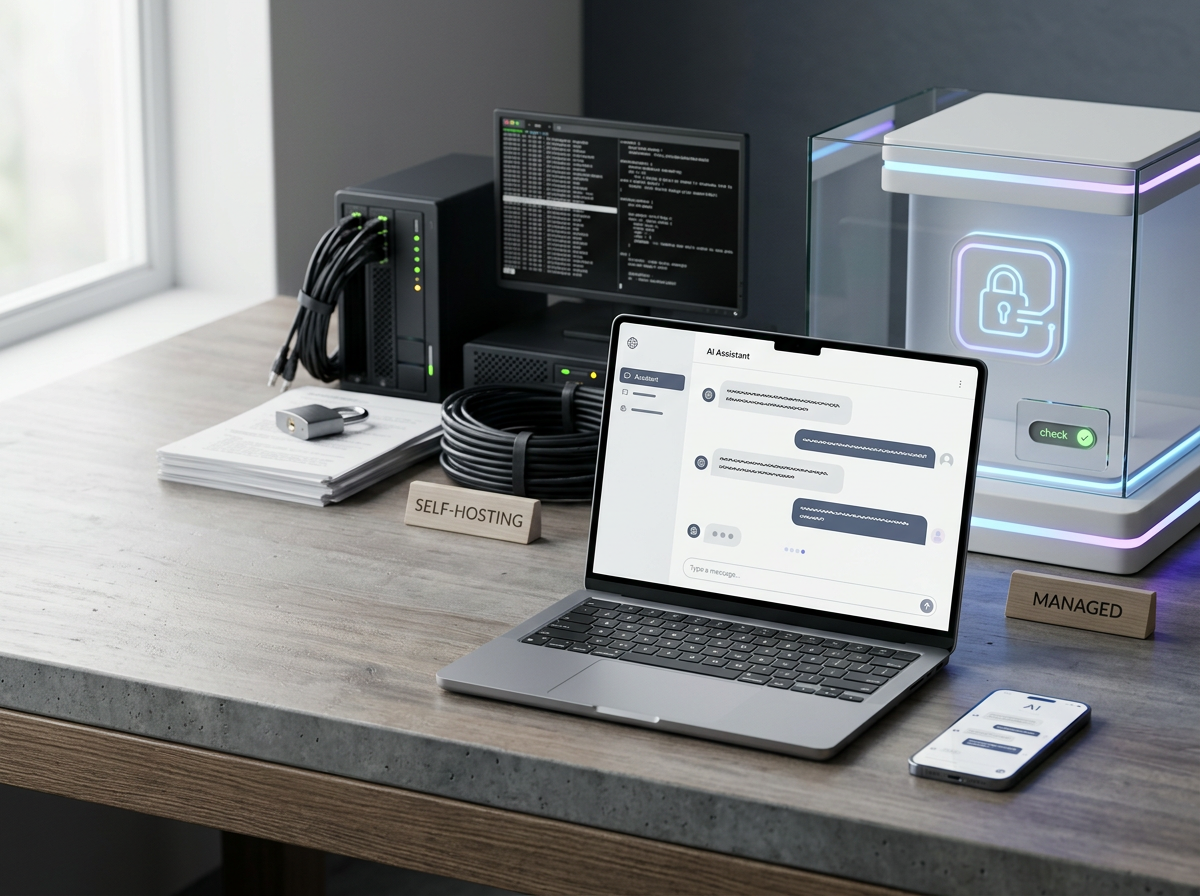
What Is Self-hosting?
Self-hosting means you're responsible for deploying and maintaining OpenClaw yourself. Typically, that involves:
- Renting a VPS or cloud server
- Installing Docker
- Configuring SSL certificates
- Setting up reverse proxies
- Managing firewalls
- Applying security updates
- Monitoring uptime
- Performing backups
- Troubleshooting infrastructure issues
For experienced DevOps engineers, that's manageable. For everyone else, it can become a significant investment.
What is RapidBot?
RapidBot is a fully managed hosting platform for OpenClaw.
Instead of configuring servers yourself, you can deploy a secure AI assistant in minutes and connect it to messaging platforms like Telegram, WhatsApp, Discord, and Slack while choosing your preferred AI provider, including OpenAI, Claude, or Gemini.
RapidBot vs self-hosting
1. Time to launch
Self-hosting
Launching OpenClaw yourself often means spending hours configuring infrastructure before your assistant is even online.
Tasks include:
- Server provisioning
- Docker installation
- SSL setup
- Security hardening
- Reverse proxy configuration
RapidBot
RapidBot handles the infrastructure automatically, allowing you to deploy an AI assistant in just a few minutes.
Winner: RapidBot
2. Security
Security is often overlooked until something goes wrong. With self-hosting, you're responsible for:
- Server hardening
- Firewall rules
- SSL certificates
- API key protection
- Rate limiting
- System updates
RapidBot includes security measures such as encrypted credential storage, Cloudflare Zero Trust, automatic SSL, and hardened server configurations by default.
Winner: RapidBot
3. Maintenance
Your AI assistant isn't finished after deployment.
It requires ongoing maintenance, including:
- Software updates
- Security patches
- Backups
- Monitoring
- Server maintenance
RapidBot manages these operational tasks automatically, including updates and backups on supported plans.
Winner: RapidBot
4. Flexibility
Self-hosting gives you complete control over your server environment.
RapidBot also provides SSH and root access while removing much of the operational burden, giving advanced users flexibility without requiring everyone to manage infrastructure themselves.
Winner: Tie
5. Multi-channel support
A useful AI assistant should be available where you already work.
RapidBot supports multiple messaging platforms, including:
- Telegram
- Discord
- Slack
You can deploy once and communicate through your preferred channels.
Winner: RapidBot
6. AI provider choice
Different AI models excel at different tasks. RapidBot lets you connect providers such as:
- OpenAI GPT
- Anthropic Claude
- Google Gemini
You can switch models without rebuilding your infrastructure.
Winner: RapidBot
7. Automation & integrations
OpenClaw becomes significantly more valuable when connected to your everyday tools. RapidBot supports community skills and integrations for services such as:
- GitHub
- Google Calendar
- Todoist
- Obsidian
- Home Assistant
This makes it easier to automate workflows without building every integration yourself.
Winner: RapidBot
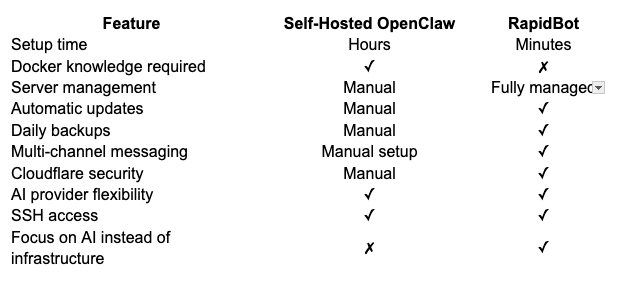
Feature comparison
Who should self-host?
Self-hosting can be a good option if you:
- Enjoy managing servers
- Have DevOps expertise
- Want complete responsibility for infrastructure
- Prefer maintaining every part of the deployment yourself
Who should choose RapidBot?
RapidBot is ideal for:
Developers
Spend more time building AI workflows and less time configuring infrastructure.
Businesses
Launch secure AI assistants without hiring DevOps specialists.
Agencies
Deploy client AI assistants quickly while reducing maintenance overhead.
Founders
Validate AI ideas faster without getting delayed by server setup.
AI enthusiasts
Start experimenting with OpenClaw in minutes instead of spending an entire weekend configuring servers.
Why managed hosting wins for most users
Infrastructure doesn't create customer value. Your AI assistant does.
Every hour spent configuring Docker, troubleshooting SSL certificates, or maintaining servers is an hour you're not improving your assistant, automating workflows, or helping customers.
RapidBot removes those repetitive operational tasks, so you can focus on what matters most.
Final thoughts
Self-hosting OpenClaw offers maximum control, but it also comes with ongoing responsibility. For many developers and businesses, that trade-off isn't worth the time spent managing infrastructure.
RapidBot delivers the flexibility of OpenClaw while handling the operational complexity for you. With managed hosting, built-in security, automatic updates, multi-channel messaging, and support for leading AI models, it provides a faster path from idea to a working AI assistant.
If your goal is to build and use AI, not manage servers. RapidBot is the smarter way to deploy OpenClaw.